



Putting spec-driven development to the test
I ran five spec-driven development kits and plain Claude Code through the same seven-step build, marked against hidden tests and blind ratings. They all got there in the end. What separated them was the bill, the amount of code, and what they did when nobody had told them what to do.

I needed to pick a way of working for a new build with Claude Code, and spec-driven development was the obvious place to start. Write the requirements down, have the model plan against them, then build. There are half a dozen kits for it now and no shortage of opinions about which one is best. What I couldn't find was anyone running them side by side on the same job.
So I did. Five methods plus a control, all building the same thing over seven steps, on the same model, marked against acceptance tests they never saw. It took about a week of machine time and roughly $3,100 of model usage (which I didn't pay for, thank you Claude Code Max).
This is the long version, with the harness, the scoring, the numbers, and the bits I'm not sure about.
The arms
Each method got its own repository, set up the way its own docs say to.
| Arm | Tested | Latest (Nov 2026) | How it works |
|---|---|---|---|
| OpenSpec | 1.13.2 | 2.0.0 | Change proposals with delta specs, archived into the main spec when done |
| cc-sdd | 3.1.0 | 3.1.0 | Requirements, design and tasks, each approved before the next |
| Spec Kit | 1.0.12 | 1.4.0 | Specify, plan, tasks, implement |
| Spec Kitty | 3.2.7 | 3.2.7 (4.0 in release candidate) | Spec Kit plus work packages, lanes and its own issue tracker (beads) |
| Superpowers | 6.4.2 | 7.0.2 | Skills for brainstorming, planning and subagent-driven development |
| Control | — | — | Claude Code with nothing installed |
I ran these in early October. OpenSpec has since gone to 2.0, Superpowers to 7.0, and Spec Kit to 1.4, so read the results as a snapshot of the versions I tested.
A few others didn't make the cut. BMAD is parked until its next release. I dropped GSD because the original repo is archived and the fork is still young. That's too much supply-chain risk for a tool with write access to my code. Kiro can't be driven from Claude Code, and Tessl's spec tile was too thin to bother with.
The control is plain Claude Code with nothing installed. If a kit can't beat that, I don't see much point paying for it in time or tokens.
The job
Every arm built a configuration subsystem for a command-line tool. It reads a YAML config (which can pull in other
files), lets you get and set values, and keeps an event-sourced history of every change. I fixed Python 3.12, uv, and
the eventsourcing library, and left everything else to the arm.
It's small, but a couple of parts are properly hard. The worst is writing changes back. People edit these files by hand and review the diffs, so setting one value can only change that value's bytes. Comments, quoting, alignment, and folded strings anywhere else in the file have to stay exactly as they were.
Then I kept changing the requirements, once per step:
- Load, show, set, and history, from scratch.
- A watcher that picks up hand edits, without mistaking the tool's own write-backs for new changes. Before this step I also pushed a commit to each repo, as if from a teammate working outside the method, to see who noticed.
showchanges meaning, and a newgetcommand takes over its old job. I wanted to see whether each method went back and fixed the old requirement, tests, and docs, or just added new ones next to them.- Lineage. Every change records who made it, how, when, and why. It touches everything, which makes it a good test of where cross-cutting work ends up.
- Two change requests in the same week, both about where new keys under a shared include should go.
- A bug report, filed as an issue in the arm's tracker. Setting a value through a YAML alias was quietly changing the anchor, and everything else that pointed at it.
- Remote
https://includes that can't be edited, plus a JSON Schema that says which URLs are includes and which are plain strings.
Every step built on the last, so the arms had to live with their own earlier decisions.
The hidden tests were how I checked correctness. With each step's brief, every arm got a written contract for the CLI: the commands and their arguments, what each one prints, the exit codes, and what the error messages have to say. I wrote acceptance tests against that contract and kept them in my harness, away from the arms' repos, so no arm ever saw them. After each step the harness installed the arm's code and ran the tests against its CLI from the outside, the same way a user would call it. Each step added new tests and kept the earlier ones that still applied, so the suite grew from 101 tests at step 1 to 161 at step 7, and breaking something old cost twice.
A few tests failed for every arm. I checked each of them against the contract, and where the contract didn't actually require what the test asserted, I dropped that test for everyone.
How the harness ran
How did I keep the comparison fair?
Mostly by being paranoid about leaks. Every arm ran in its own container with its own Claude Code config directory, so nothing installed for one arm could reach another. I have Superpowers installed in my normal setup, and without that separation it would have turned up in the control. Auto-memory was off, and so was telemetry wherever the tool let me turn it off.
Every arm used Claude Opus 5.5 on the same pinned Claude Code version. I'd seen an unpinned run fall back to a different model, so the runner checked the model on every assistant message in every transcript, subagents included. A mismatch meant the step ran again.
Keeping the hidden tests apart from the arms still needed care. pytest's early conftest discovery was picking up each
arm's own conftest.py and running it inside my test run, until I caught it.
Somebody also had to answer the arms' questions. If I'd done it live, later arms would have had the benefit of my earlier answers. Instead a product owner agent answered from a written brief I'd signed off before anything ran. It gave the same answer to the same question, but it only answered what was asked and never volunteered anything.
Each step ran twice. The first run, discovery, stopped at the arm's first approval request or its first edit to code. Anything it asked that the brief didn't cover came to me, and my answer went into the brief. I then checked those answers against each other, so overlapping questions got the same answer. The second run started again from the same commit and went to completion with the updated brief, and that's the one I scored.
Nothing new came to me during a scored run. If an arm asked something the brief didn't cover, it got the same reply every time:
The brief doesn't cover this. Make the safest assumption (the one least likely to lose or corrupt a user's data or to contradict the contract), record it as a decision with your reason, and carry on.
That stopped the brief changing halfway through a step, and it showed me what each arm thought "safe" meant.
Arms ran one at a time. Spec Kitty and cc-sdd also stop at their own approval gates, and I answered those myself.
What I scored
Every arm passed nearly all of the hidden tests, so correctness was never going to separate them. The total was out of 100, across eight dimensions:
| Dimension | Weight | What it covered | How |
|---|---|---|---|
| Correctness | 20 | Hidden tests passed, every step, all earlier tests included | Measured |
| Coping with change | 20 | Regressions, stale requirements and tests updated, churn in files that had no reason to change, spotting the hand edit | Mostly measured |
| Code quality | 15 | Mutation score, mypy --strict errors and lint findings per 1,000 lines, test names against what they assert, code size | Measured, names judged |
| Decisions | 15 | My blind rating of each design choice, plus whether options were weighed and recorded | Rated and judged |
| Interaction | 10 | Value of questions, research before asking, approval gates at sensible points | Judged |
| Time and cost | 10 | Working time and cost per step, against the median arm | Measured |
| Setup | 5 | Setup effort, fit with Claude Code, process violations | Mostly judged |
| Traceability | 5 | Requirement to test to code, change to reason, the bug fix leaving a spec trace | Judged |
For the judged parts I used three model judges, each told to read from a different perspective. They worked from anonymised copies of the repos and an anchored 0-4 rubric. I took the median and kept their disagreements visible instead of averaging them away. Then I went through every disputed item, every judgement that decided a top-two place, and a random sample of the rest, and recorded my verdict next to theirs.
I rated the design decisions myself, blind. I pulled 118 decision topics out of the six codebases. On 27 every arm did the same thing, on 83 they went different ways, and on 8 only one arm thought about it at all. I scored each route out of 5 without knowing whose it was.
Time, cost, and code size are scored against the median arm at each step, on a log scale, capped at ten times either way. Being twice as expensive costs the same points whether it's $2 against $1 or $200 against $100.
Anything I couldn't measure dropped out, and its weight went to the parts I could measure, so it never counted as zero. The control's mutation score is the main case. Its tests drove the CLI as a subprocess, which mutmut can't trace coverage through, so mutation testing decided it had no tests at all. That says more about my harness than about the control.
Lint findings the linter can fix by itself count as a tenth of a finding. OpenSpec's lint count went from 8 to 34 over the build, and 31 of those were unsorted imports that one command fixes. Counting them in full would have been scoring my ruleset.
Results
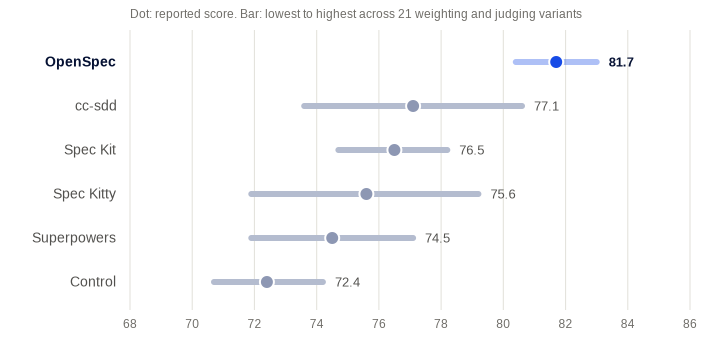
OpenSpec came out ahead. The other five are too close together to rank.
To check that, I moved each dimension's weight five points up and down. I also swapped every disputed judgement for the most generous judge and then the harshest, and tried both at once. OpenSpec stayed first in every variant, with totals between 80.4 and 83.0. The places below it moved around in 21 of them. Give time and cost five more points and Superpowers comes second. Take five off interaction and Spec Kit does.
I also changed some weights after the runs had finished. Decisions went from 10 to 15 and time from 5 to 10, because watching the runs changed my mind about what mattered. That's a fair reason to be suspicious of the result, and it's why I ran the sensitivity check. The winner didn't move.
Where the points came from
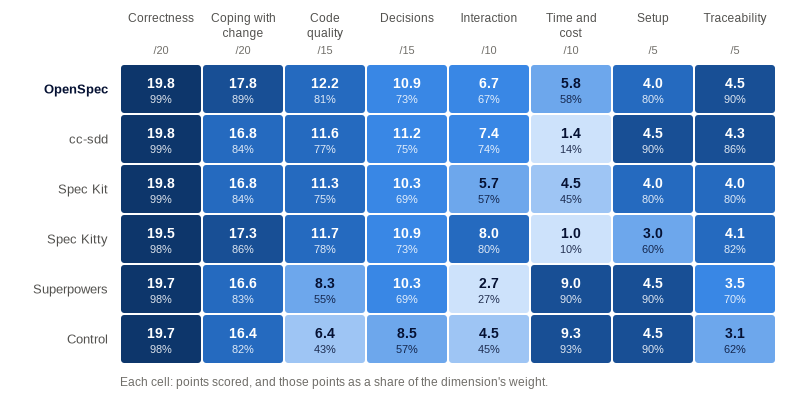
Each cell shows the points an arm scored in a dimension, and underneath, those points as a share of the dimension's weight. OpenSpec scored 12.2 out of 15 for code quality, which is 81%.
Correctness barely varies. Every arm passed 97% to 99% of the hidden tests at every step, the control included, and none of them broke anything from an earlier step. Coping with change was close as well, at 82% to 89%.
Most of the difference sits in time and cost, interaction, and code quality, and those trade off against each other. The two cheapest arms had the weakest code and asked the fewest questions. The two most expensive asked the best questions and wrote the most heavily tested code. OpenSpec was near the top of most columns without leading any of them by much, and that was enough to win.
Cost
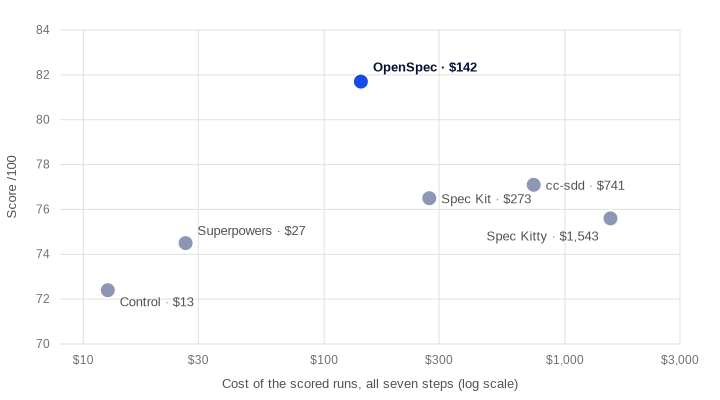
| Arm | Working time, all steps | Cost, scored runs | Discovery runs |
|---|---|---|---|
| Control | 48 min | $13 | $10 |
| Superpowers | 54 min | $27 | $10 |
| OpenSpec | 2 h 49 min | $142 | $46 |
| Spec Kit | 5 h 22 min | $273 | $84 |
| Spec Kitty | 23 h 44 min | $1,543 | $45 |
| cc-sdd | 40 h 57 min | $741 | $132 |
The cheapest arm cost about a hundredth of the most expensive. Past OpenSpec, more money didn't buy a better score. Spec Kitty spent eleven times as much and finished six points lower.
cc-sdd spent about 30 of its 41 hours running and re-running tests. Spec Kitty spent 4.5 hours reviewing its own work packages, more than it spent writing specs. OpenSpec put about a quarter of its time into specifying.
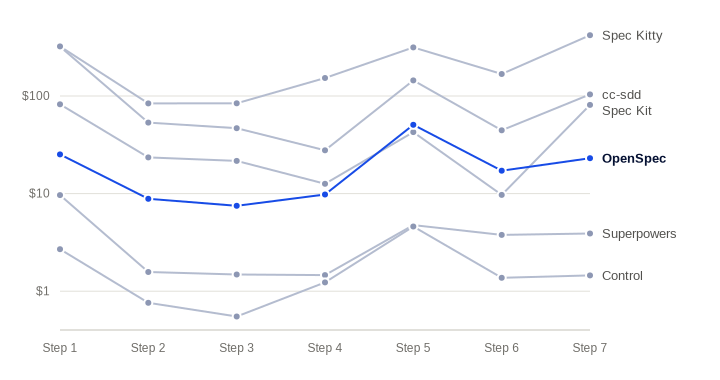
I expected the heavier methods to spend big on step 1 and get cheaper as the spec settled. cc-sdd did. It dropped from $320 to $53 after the first step. Spec Kitty didn't. Its most expensive step was the last one, at $419, and the order of the arms barely changed from one step to the next.
Code
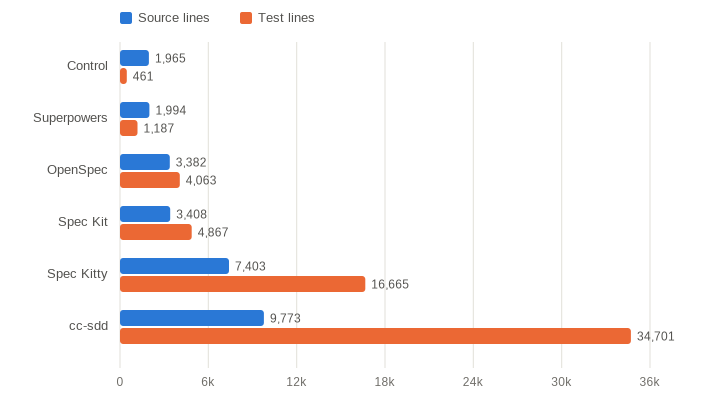
Same features, same hidden tests, and cc-sdd wrote five times as much source as the control to get there. Its tests came to three and a half times the size of its source, or 44,000 lines of Python all up... for a config tool.
I'd rather have less code. It's easier to reason about, and it usually means the arm used a library instead of writing its own. So source size counts in the code quality score, against the median arm, with nothing extra for going below half the median (code can be too terse as well). Test lines don't count against anyone, because I don't want to put anyone off testing, but 34,000 lines of tests is a lot to maintain.
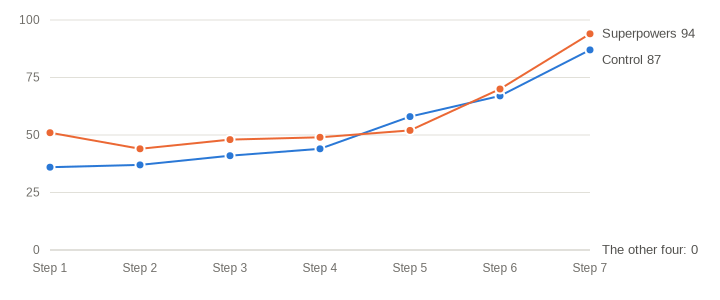
mypy --strict errors in source code, by step.All four spec methods finished every step with no mypy --strict errors. The control went from 36 to 87 and rose at
every step. Superpowers went from 51 to 94, with a small dip at step 2. Both had about 2,000 lines of source, so the
errors were piling up faster than the code was growing.
Mutation scores ranged from 0.72 (Spec Kit) to 0.87 (OpenSpec). Test names ranged from
test_get_of_a_collection_exits_5_naming_the_path_and_pointing_to_show, which tells you exactly what broke, down to a
single test_watch that checked six unrelated things.
Questions and approvals
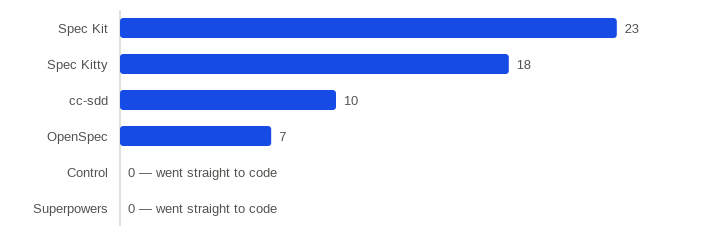
The control and Superpowers never asked anything in a discovery run. They went straight to code every time. The others asked between 7 and 23 questions.
Spec Kit asked the most, nearly all of them in discovery, and then built without stopping. If you only looked at its scored runs you'd think it never asked anything, which is why I counted both. Spec Kitty was the only arm that asked useful questions at every step and in both runs. It also took the most of my time, with 36 minutes at its approval gates against four minutes for cc-sdd and none for the rest.
What bothered me more was how often an arm didn't ask. It would make a design call itself, build it, commit it, and mention it in the summary at the end of the step. One summary had a heading, "Calls I made where the contract left room." Plenty of those calls were fine, but by the time I read them more work was sitting on top, and I'd rather have been asked first. In one step an arm did ask me something, then answered its own question in its decision log before I'd replied.
OpenSpec timed its approval requests best, with 0.89 of the points available for gates. Superpowers got 0.32.
Decisions
My blind ratings of the arms' design choices were closer than I expected, from 0.61 for the control to 0.72 for cc-sdd and Spec Kitty. The methods didn't make the model much better at deciding things. They did make it write decisions down: recording the options and a reason scored between 0.71 and 0.79 for the methods, and 0.50 for the control.
The differences showed up in decisions only one or two arms thought to make. Only cc-sdd decided what deleting a value
should do to the comments around it, and every other arm lost comments in some cases. Only Spec Kitty thought about a
UTF-8 byte order mark (the others kept it by luck). cc-sdd, Spec Kit, and Spec Kitty wrote files atomically, through a
temp file, fsync, and a rename. OpenSpec wrote in place, so a crash halfway through a write could leave a truncated
config. I gave that 3 out of 5, and it's the OpenSpec choice I'd most like to change.
Same design, different behaviour
Arms that described the same approach to a design question often did different things when I ran them. One kept a comment where another dropped it. Two refused the same bad input with different exit codes. Going by their specs and design notes, you'd have said they agreed.
So I stopped rating what the arms said they'd done. For each decision I wrote examples, ran them against every arm's final code, and rated what happened. It was slow, and if I were evaluating AI-written code again I'd start that way.
What got in each method's way
Claude Code itself caused very little trouble. Most of it came from the methods.
OpenSpec does its real work through a separate CLI, so the model had to call it from the shell and parse the output. Its archive step also stops to ask an interactive question, which stalls an unattended run.
cc-sdd was the slowest by a long way. The model had to remember the order of the phases and record approvals by hand.
Spec Kit expects a branch per feature, so the model kept hand-writing a pointer file to let it work on main.
Spec Kitty's own status checks blocked it. The model wrote helper scripts to get around them and kept using them for the rest of the build. Its tracker also needed a configuration change the docs don't mention before it would connect.
Superpowers only started its workflow in one of the seven steps. In the other six the model went straight to code, which is why its score ended up so close to the control's.
The bug report
Five of the arms got step 6's bug as a GitHub issue. All five fixed the bug and left the issue open, with no comment and no link to the fix. None of those methods has a step that writes back to the tracker. Spec Kitty keeps its own tracker, and it did close its copy and link the commit.
OpenSpec was the only arm whose fix traced all the way back through the spec. The judges gave it full marks there, and 0.75 to everyone else.
Problems every arm shared
A few defects turned up in all six arms, in areas my spec didn't cover:
- some values
getprints mean something different when you paste them back into the file - history can show an old value until some other command happens to run
- a command waiting on a lock waits forever
Six separate implementations with the same bug means the gap was in my spec, and none of the methods found it. None of them asked what a user would do next with the output, so that question is still mine to ask.
What I'd tell someone choosing
I'm using OpenSpec. It came first under every weighting I tried, did best on traceability, wrote a moderate amount of code, and cost about a fifth of what cc-sdd did. I've changed three things about how I run it. I answer its archive question up front so unattended runs don't stall, and I run the linter and type checker in the pipeline. I've also added my own approval gates for the questions it doesn't ask.
If cost and speed matter most and you're going to review every diff anyway, plain Claude Code passed the same tests at a hundredth of the price. The catch is the type errors piling up and the decisions nobody wrote down.
Spec Kitty asked the best questions of anyone. If you've got the budget, and the time to answer them, it's worth a look. Just know it took more of my time than every other arm combined.
I wouldn't use cc-sdd for this kind of work. Its decisions rated joint best and its traceability was close to the top, but 41 hours and 44,000 lines is a lot for a config tool.
Limits
It was one command-line tool, built once, on one model. I rated the decisions myself, and I wrote some of the rubrics after the first five steps had run, so the scoring wasn't all set in advance. The anonymising only went so far. Each method's vocabulary and folder layout tends to give it away, and I suspect the judges could tell. The arm with its own tracker also had slightly different network access from the ones using GitHub.
I'd like to re-run the top two and the control on a second model, and on a different kind of build (probably something with a UI). The harness is built to run again. If you've done a comparison like this, or you're picking a method for your team and want to talk it through, get in touch.
Want to discuss this?
We'd love to hear your thoughts. Drop us a note and we'll get back to you.